Fruit powders can appear similar on a specification sheet, yet the drying technology used during production significantly influences their performance in formulation. We will use açai (Euterpe oleracea), known for its intense pigmentation and lipid content, as an example to explain the impact of spray-drying or freeze-drying in the final fruit powder.
The choice between these two technologies affects composition, hygroscopicity, sensory retention, dispersibility, and final application behavior.
What happens during spray-drying?
Spray-drying converts fruit pulp or juice into powder by atomizing the liquid feed into a stream of heated air. Water evaporates rapidly, and dry particles are collected in a continuous industrial process. Because açai pulp contains sugars and lipids that can create stickiness during drying, carrier agents such as maltodextrin are frequently used to stabilize the process and improve powder formation.
As a result, spray-dried açai powder often contains additional ingredients beyond the fruit itself. The presence and proportion of these carriers influence flavor intensity, color density, and powder behavior in formulation.
From an industrial perspective, spray-drying offers advantages in scalability, batch-to-batch consistency, and cost efficiency.
How does freeze-drying differ?
Freeze-drying, also known as lyophilization, removes water through sublimation at low temperature and reduced pressure. Because the process avoids high heat exposure, it is generally associated with better preservation of heat-sensitive compounds such as anthocyanins and volatile aroma components.
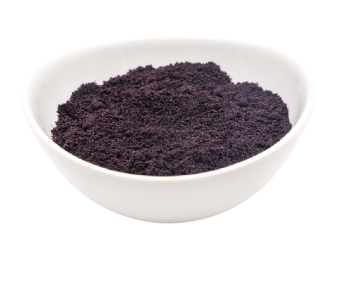
In the case of açai, this may translate into deeper color retention and more pronounced sensory characteristics. Freeze-dried powders typically contain a higher proportion of pure fruit solids, as carrier agents are not inherently required for structural stabilization during the process.
However, freeze-drying is slower and more energy-intensive, which can influence production cost and scalability.
How do carrier ingredients influence the final product?
One of the most relevant formulation considerations is the presence of carrier agents in spray-dried powders. These ingredients are added to improve drying efficiency and powder stability, but they dilute the concentration of fruit solids in the final material. This dilution can affect:
- Color intensity in beverage applications
- Flavor strength per gram of powder
- Nutritional density per serving
- Label positioning, depending on formulation strategy
Understanding the ratio between fruit solids and carrier agents is essential when evaluating specification sheets.
What about hygroscopicity and storage behavior?
Açai powders, like many fruit powders, are inherently hygroscopic due to their sugar composition. Hygroscopicity influences caking tendency, flowability, and packaging requirements.
How are aroma, color, and flavor affected?
Freeze-drying is frequently associated with stronger retention of anthocyanins and aroma compounds due to its low-temperature processing conditions. This may result in more intense purple coloration and closer resemblance to fresh fruit characteristics.
Spray-drying, involving exposure to heated air, can lead to partial degradation or transformation of volatile compounds. While this does not eliminate functional performance, it can slightly alter the sensory profile of the powder.
The impact becomes particularly relevant in premium beverage formulations or applications where visual intensity is central to product positioning.
Which method performs better in beverage applications?
Dispersibility and solubility are practical considerations for beverage systems.
Spray-dried powders often disperse more easily in water because carrier agents improve wettability and reduce clumping. Particle morphology tends to be more uniform, which can facilitate reconstitution.
Freeze-dried powders may require additional milling or agglomeration to optimize dispersibility, depending on the desired application.
The appropriate choice depends on whether the priority lies in sensory intensity or ease of processing and reconstitution.
Final considerations
The decision of which açai powder to use should be guided by formulation goals, sensory expectations, processing constraints, and labeling strategy.
For açai powder applications, key variables to evaluate include:
- Presence and percentage of carrier ingredients
- Target sensory intensity
- Moisture sensitivity and packaging strategy
- Required dispersibility in beverage systems
- Cost and scalability considerations
Understanding how drying technology shapes powder behavior allows for more informed ingredient selection and better alignment between technical performance and product positioning.
References
1) Shishir M, Chen W. A critical review on drying of fruit and vegetable juices. Trends in food science & technology. 2017;65:49–67. https://doi.org/10.1016/j.tifs.2017.05.006
2) Garofulić IE, Dragović-Uzelac V, Režek Jambrak A, Jukić M. Optimization of sour cherry juice spray drying as affected by carrier material and process parameters. Foods. 2016;5(2):28. https://doi.org/10.3390/foods5020028
3) Etzbach L, Pfeiffer A, Weber F, Schieber A. Effects of carrier agents on powder properties and stability of phytochemicals in spray-dried plant products. Current research in food science. 2020;3:57–71. https://doi.org/10.1016/j.crfs.2020.03.001
4) Shuen GW, Yu HH, Chang YJ. Effects of drying methods on physicochemical properties of fruit powders. Brazilian journal of food technology. 2021;24:e2020183. https://doi.org/10.1590/1981-6723.08620
5) Li S, Wang Y, Zhang L, et al. Comparative analysis of drying methods on volatile compounds and quality attributes in fruit powders. Foods. 2023;12(13):2496. https://doi.org/10.3390/foods12132496